Kottke has a rundown on the recently released 4K restoration of Seven Samurai. Funny he mentions getting a Blu-ray player and returning to physical media… I just bought a handful of favorites from Criterion a few weeks ago. Feels good to have a real backup in case, you know, the worst happens.
Rewatched Twin Peaks: The Return and can reaffirm, it still operates on its own masterful level of cinema.
It’s David Lynch’s magnum opus, and it will stand the test of time as one of the absolute best films/shows ever conceived.
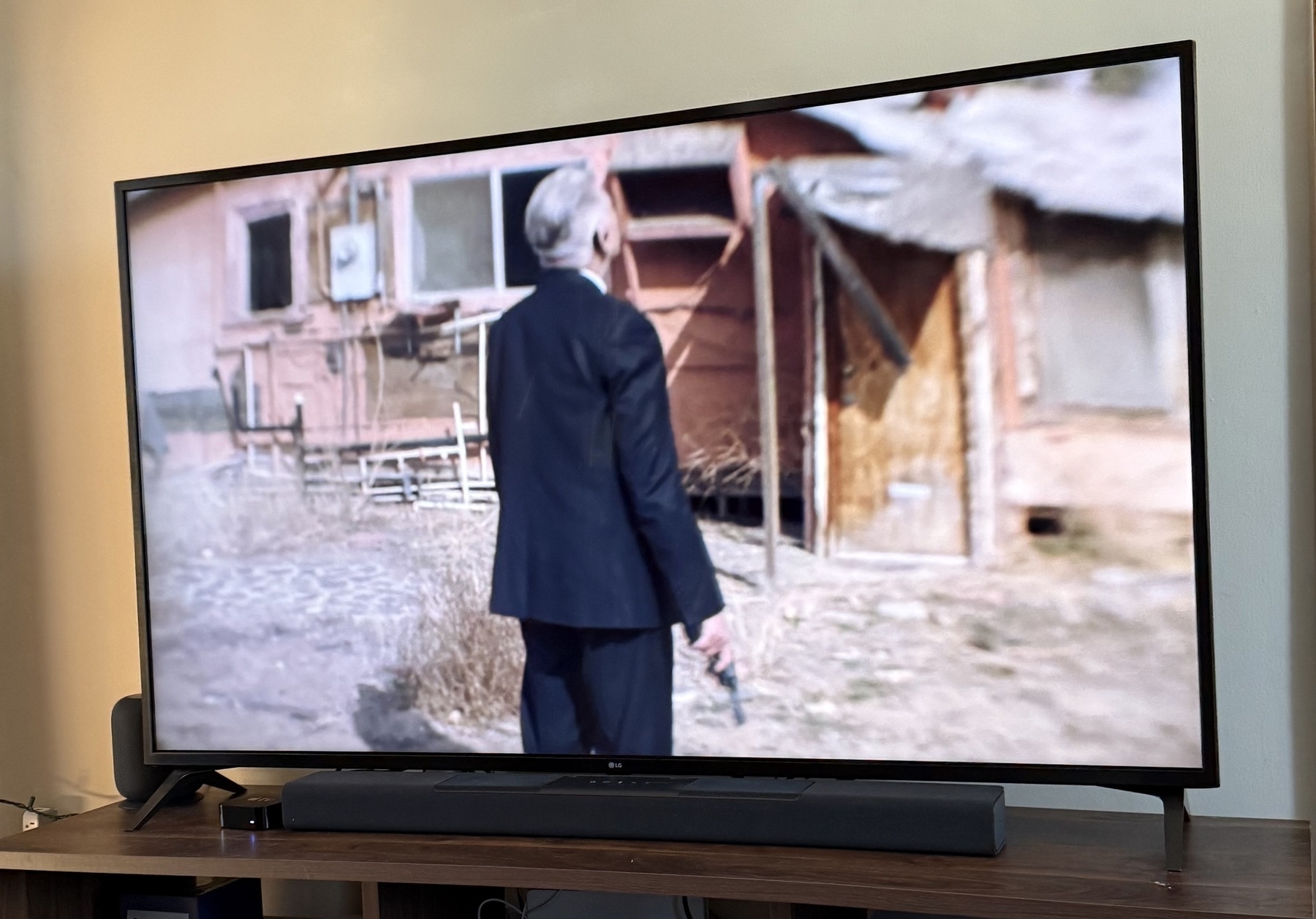
Watched the French film The Taste of Things twice this past week, and can’t get its immaculate vibe out of my mind. My wife said it best — it’s like ASMR for food obsessives. If you like cuisine, cooking, the details of hospitality, or a lovely, focused, quiet cinema experience, this if for you.
True Detective: Night Country was a succinct masterclass in whodunit that delivered a rewarding cohesiveness to all character arcs. It’s too bad it was only six episodes — it was drenched in a blustery winter vibe that was enjoyable to visit — but it was also the perfect length.
Scavengers Reign is one of the most surprising, strange, and best shows of the year. So glad I happened upon this – binged the entire thing in two days.
MUBI’s Printed Notebook (film magazine)
Just received my first issue of MUBI’s Notebook, and it’s an incredible print production. Absolutely love a surprise and delight moment with anything I wasn’t expecting to have such a moment with, and this hit the mark.
MUBI is a niche/classical/independent/international film streaming service that’s been around for over a decade (I originally subscribed back in 2010). I recently re-subscribed and learned that they were producing a bi-annual magazine that accompanies the company’s super-focused spotlight on cinematic experiences.
And it is a beautiful object.
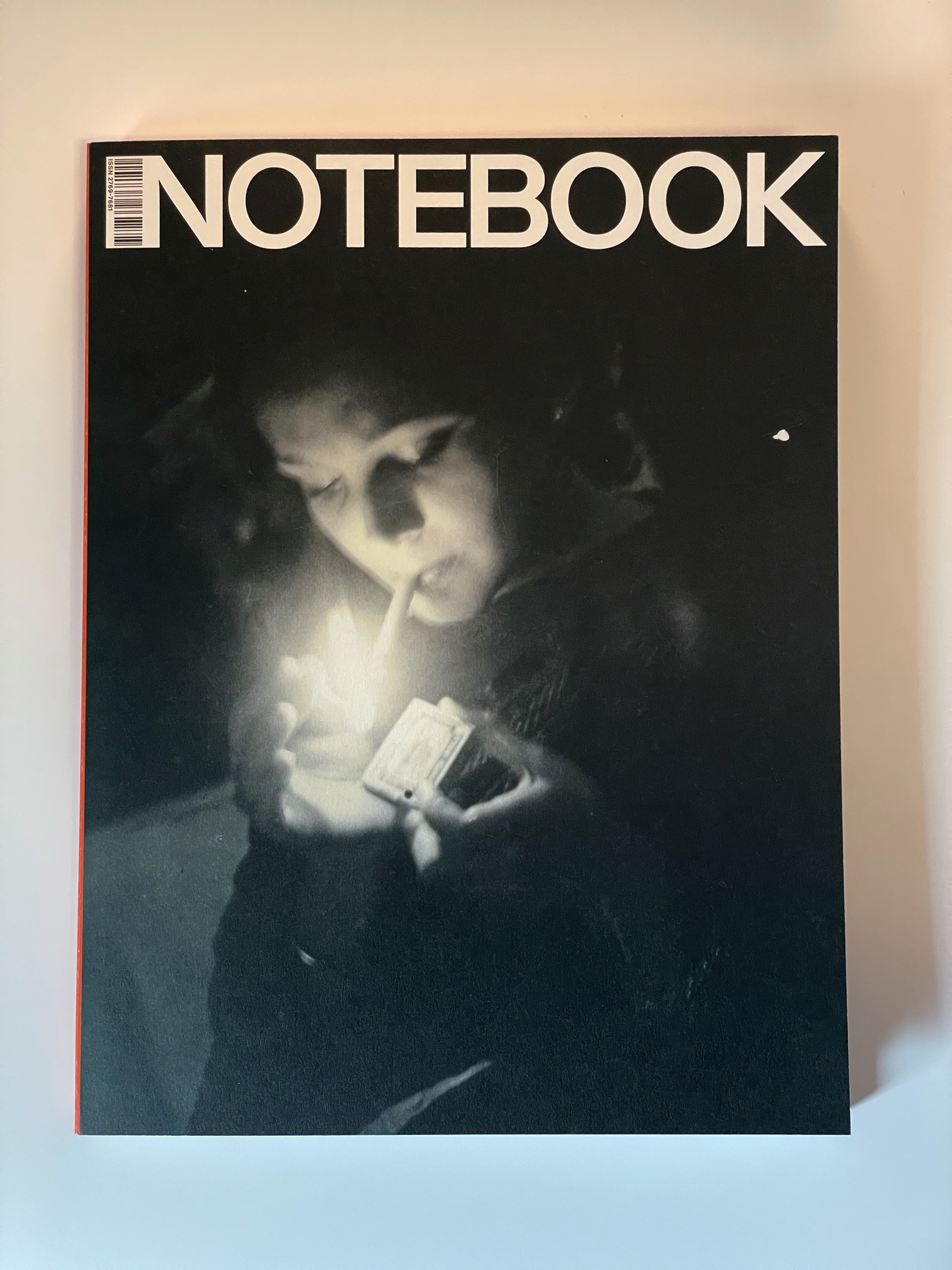
- It ships in a magazine-sized box (not plastic wrap!)
- The magazine inside is wrapped with a re-usable, water-resistant sleeve that makes the printed pages inside feel cared for
- The pages are printed on thick, punchy stock that feels unlike any other magazine, including the crown jewel, Monocle
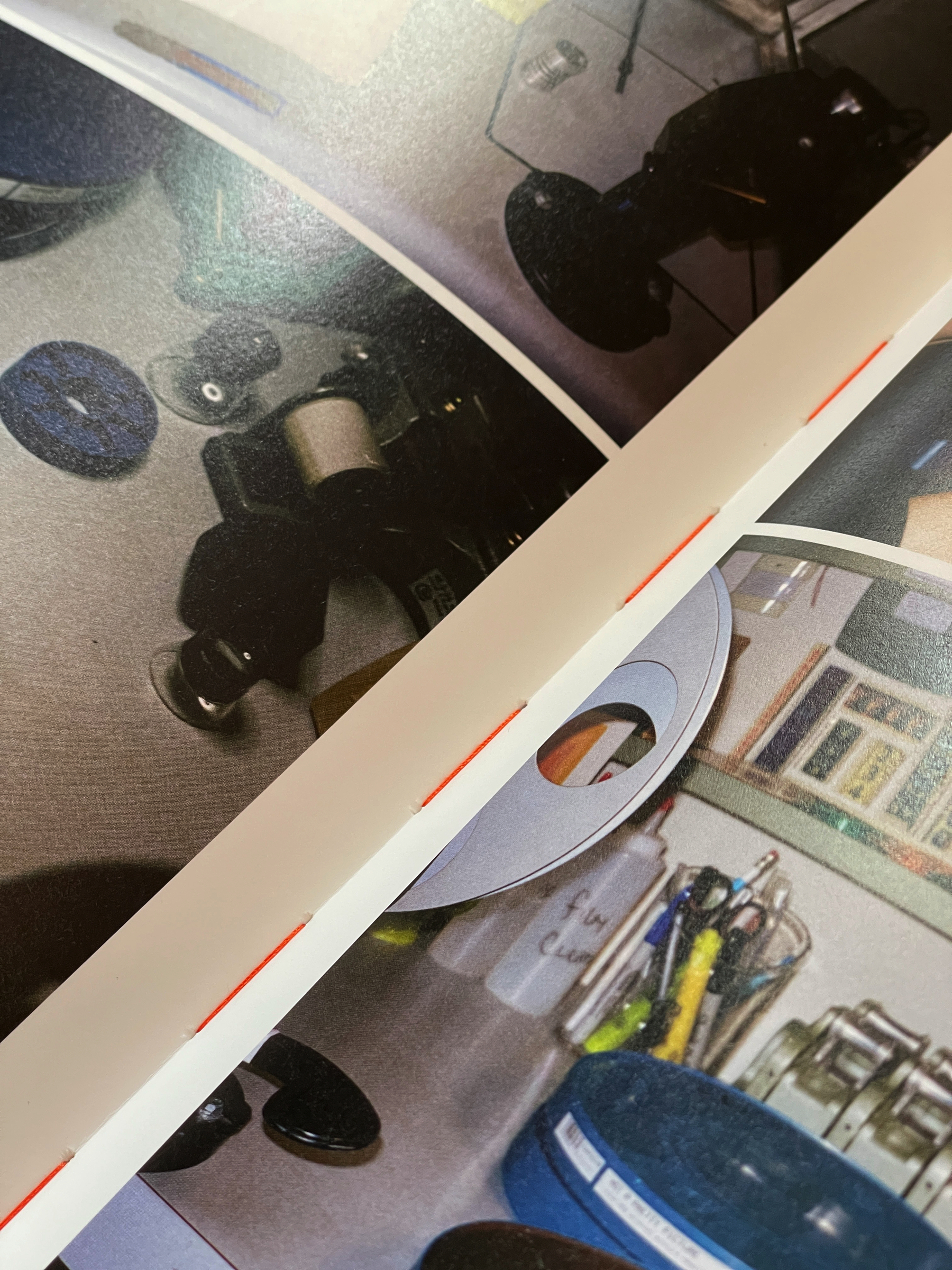
- Lay-flat design, so you can open any part of the magazine and keep it comfortably open without the pages curling back around
- Beautiful orange stitching throughout, which is… notable
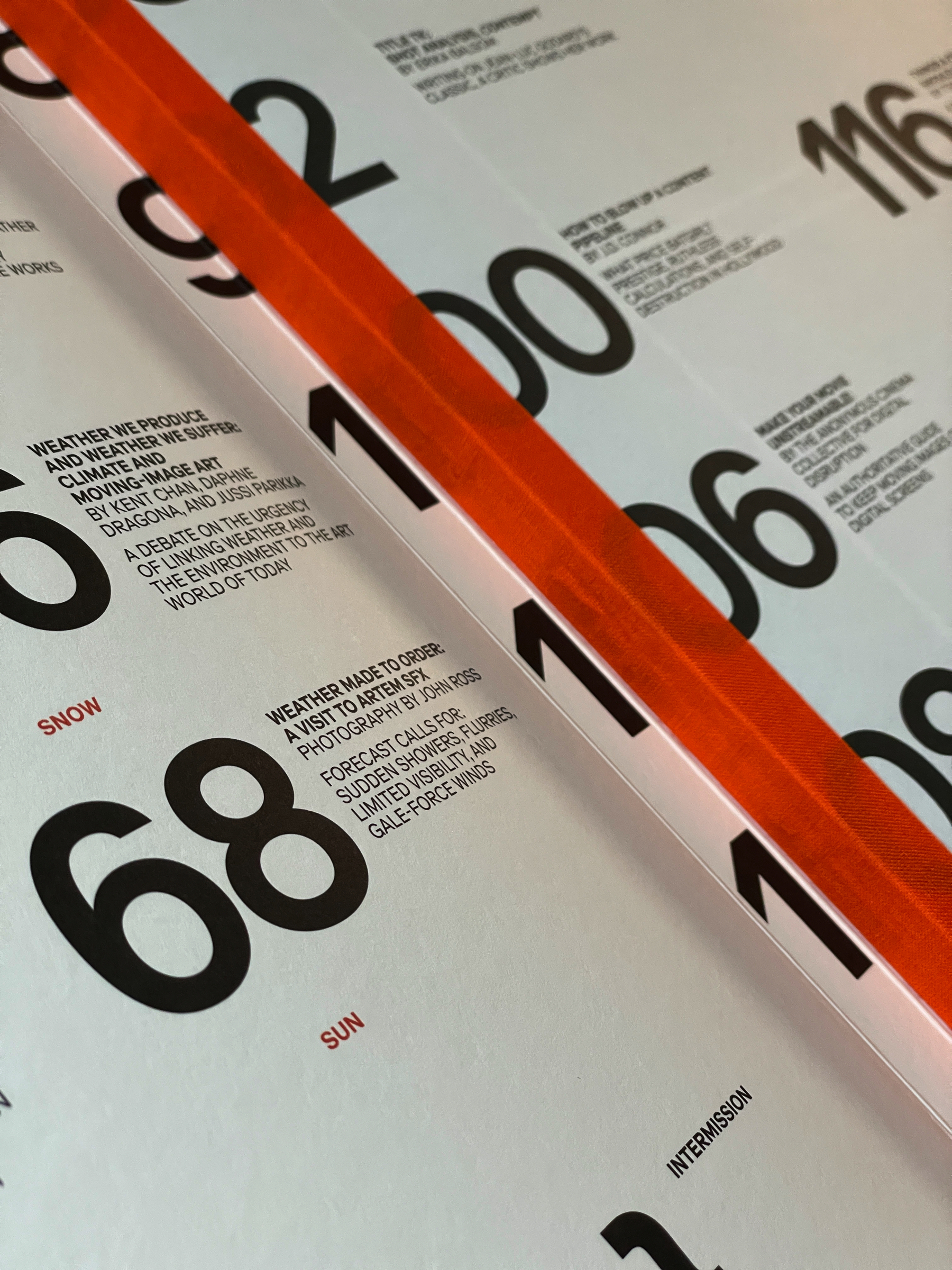
This issue (#3) is dedicated to weather throughout film:
…saboteurs are afoot and unpredictable weather is in the forecast! With thematic pieces devoted to the appearance of weather inside and outside of movies—w(h)e(a)ther cataclysmic or beautiful, documented or created—and to the disruptive ways film culture and industry can be sabotaged, this Issue is expected to reach record readings (!).
I’ve only just begun paging through it, but it’s a joy to read and see so far. Highly recommend — keep print alive!
Another cinema rant: Khoi Vinh observes Wes Anderson like he truly is, for better or worse:
Anderson is essentially a children’s storyteller. For my money, he’s most at home when he’s telling stories through the lens of child characters
I haven’t seen Asteroid City (honestly, not planning on it). But… Barbie and Oppenheimer were fantastic.
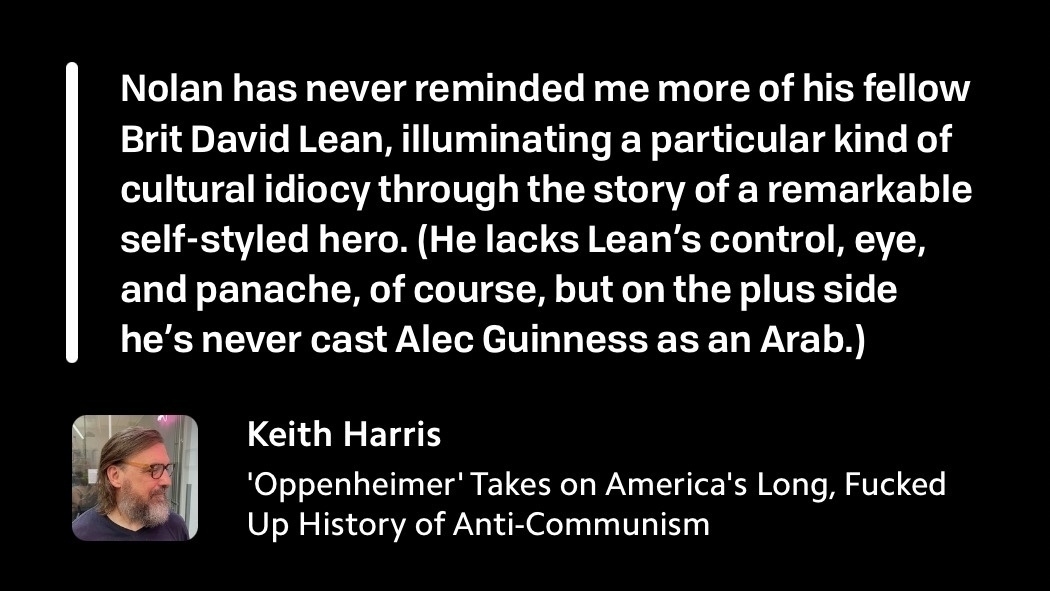
While I enjoyed Oppenheimer, Keith Harris’s full review here helps solve my askew feelings about it.
Our Fascination with Violence
Our cultural fascination with violence is endless. When it comes to meeting it up close in various media forms, its reception is also very dependent on the lens of the gazer – are you bringing your critical, introspective brain to the party, or are you watching for bloodlust?
I enjoyed this piece from Dylan Walker over at Trylon Cinema's Perisphere Blog. They were showing the Dirty Dozen earlier this month, and... why not put out some commentary on this. It includes worthy comparisons to The Last of Us (both the game and the TV series), but this line of thinking should be applied to all major forms of violent media -- particularly those brought in as sacrificial lambs in the news media or as "inspiration" from violent offenders here in America.
Adding to creators' rightful defense of violence as a means of storytelling and, in The Last of Us Part 2 game in particular, a twisting of the concept of revenge through a player's agency, Dylan notes:
I wholeheartedly agree with messages that are anti-war and anti-revenge. I also don’t agree with censorship and believe Aldrich and Druckmann aren’t responsible for consumers misinterpreting their intended messages. Furthermore, I think the human desire to test ourselves with exposure to violence is natural, especially when we are so surrounded by violence every day; so I’m not going to report myself or anyone else who consumes violent media.
I've changed my mind significantly over the decades from watching film as a literal process or as entertainment vs watching as a critic and admirer of the medium. The violent and ostentatious films seen at a much younger age vs fully developed adult (you realize "oh, this film is actually a condemnation of this kind of thinking"), typically stack up as lessons in both empathy and critical thinking. I'm thinking of Pulp Fiction and Fight Club as two great examples here. Seeing them (albeit probably at too young an age), and revisiting in later years, totally changed my mind about what those were actually about.
This kind of obsession with violence is interesting – we condemn it, but we are also fascinated with it. (The popularity of the horror genre... same thing.) So we should continue to look the violent-leaning outputs of any medium as expressions of its creator(s) to allow for a meaningful reaction worthy of critical thought, and/or an influence on agency in the case of a game experience that continues to itch our curiosity here, but also keeps us in check on over-indulgence and intentional reflection.
The Millennial Appeal of A24
Over the last seven years, a small New York studio’s films crept into the film distribution scene. I only started recognizing the studio’s logo lede after about the third time. Its intertwining lines shaping ‘A24’ was an entirely different, stylistically clean animation from the excessively ornate nonsense of its peers. It probably helped that each film I saw attached to it was exceptionally memorable. The time it finally clicked was watching the 2016 film, The Witch (inside the then-new Arclight theater in one of Chicago’s most yuppie neighbhorhood). Since then, I’ve been following A24’s activities and fervently anticipating just about every one of their imminent titles. Only two other film studios come to mind that equal such enthusiasm, and both have far longer stretches between film releases: Lucasfilm and Pixar.
Thinking back, Harmony Korine’s absurdist, anti-summer vacation flick Spring Breakers was probably my first A24 film. I recall going into that one thinking one thing, and a quarter of the way through thinking the exact opposite — undermining your expectations so astutely way was a wonderful thing.
Every year now, A24 has a few films that hit a fervor of mainstream discussion. This year it’s French director Claire Denis’s High Life, which I have unfortunately not seen yet, but have read the NYT interview and listened to A24’s podcast between her and Rian Johnson — it sounds fabulous. Three years ago it was the Academy Award-winning Moonlight, a freshman effort by the young Barry Jenkins. I was disappointed that in 2017 The Florida Project didn’t receive the award accolades it deserved, but what a phenomenally-acted film that was. A24 cranks out consistently good fare, ruminating and thoroughly exploring scripts and completed films to distribute. And since Moonlight, they have begun funding and distributing some their own films (albeit most disappointingly with the recent David Robert Mitchel film, Under the Silver Lake, which was just recently distributed straight to streaming instead of a more formal theatrical release).
In addition to the consistency in quality, A24 successfully accomplishes unique contributions to its work to bolstering marketing efforts, notably standing out to a new generation of audiences, and addressing the changing technological formats of distribution.
- A24 does a stellar job with film posters. They are oftentimes off kilter, using colors and typefaces in direct opposition to adjective thumbnail images of films when scrolling through lists in whatever app you’re using to pick a film. They usually don’t follow traditional patterns, compositions, or styles, oftentimes reminding me of enthusiastic graphic designers’ riffs on classic film poster designs as fanfare.
- The trailers are wholly untraditional, operating more as teaser previews for the films whilst avoiding detailing out the entire narrative like so many other distributors. A24 is getting (or have already gotten?) to the point of relying entirely on brand. What a millennial convenience.
Founded by Daniel Katz, David Fenkel, and John Hodges back in August of 2012, A24 has had and continues to pave an independent legacy of great film production and distribution. As the technology/streaming services become more complicated, and production of film and prestige television become more competitive, it’s good to see a company carve out a sort of niche in storytelling and film aesthetic, which they dial directly into their desired audiences. Like so many of the “millennial” direct-to-consumer brands such as Quip, Flamingo, Harry’s, Burrow, YES PLZ Coffee, Casper, Parachute, and Away, A24 is synonymous with consistent expectations (or the thrill of undermining expectations in traditional film structure). I wouldn’t be surprised if they charged a subscription fee to help fund their more experimental films in the future, uplifting the film production paradigm further. They’ve become such a prized product that recently they’ve partnered with HBO (for the show Euphoria), Hulu (for the show Ramy), and a partnership with Apple for their upcoming Apple TV+ service.
It’s great to see a scrappy, well-directed company succeed on so many fronts while staying true to its nature in the modern era of convoluted entertainment production and distribution. Fingers crossed they keep it up.
Saga of the Leftovers
How do we deal with the fragility of life? How do we cope with lost love and lost family? How do we contend with the forces of nature, the forces of mortality? It took some patience, and some diligence, but I powered through the first season of HBO’s The Leftovers through all the perceptively melancholy, depressing episodes to get here: season 2.
If you for some reason don’t know, HBO endorsed and funded the creation of a series based on American author Tom Perrotta’s novel about the sudden disappearance of two percent of the world’s population, and the events that followed in a small town. That’s actually all you need to know. This series isn’t necessarily about a post-apocalyptic struggle for characters traumatized by a single, life-defining moment; rather, the series in an introspection on pathos and how to interpret the unknowable: through theological or logical reasoning. To build a show respectful of both disciplines of thinking, whilst furthering the development of characters and theme, is quite an accomplishment for show runner Damon Lindelof (yes, the same Damon Lindelof who brought us Lost).
<div
    class="
      image-block-outer-wrapper
      layout-caption-below
      design-layout-inline


    "
    data-test="image-block-inline-outer-wrapper"
>


    <figure
        class="
          sqs-block-image-figure
          intrinsic
        "
        style="max-width:100%;"
    >


      <div


          class="image-block-wrapper"
          data-animation-role="image"
data-animation-override
      >
        <div class="sqs-image-shape-container-element


          has-aspect-ratio
        " style="
            position: relative;

              padding-bottom:20.55137825012207%;

            overflow: hidden;-webkit-mask-image: -webkit-radial-gradient(white, black);
          "
          >

              <noscript><img src="https://cdn.uploads.micro.blog/25423/2023/018b5c32b1.jpg" alt="" /></noscript><img class="thumb-image" src="https://cdn.uploads.micro.blog/25423/2023/018b5c32b1.jpg" data-image="https://cdn.uploads.micro.blog/25423/2023/018b5c32b1.jpg" data-image-dimensions="1197x246" data-image-focal-point="0.5,0.5" alt="" data-load="false" data-image-id="566fab9e05f8e2da90829a93" data-type="image" />

        </div>
      </div>


    </figure>


</div>
And this is coming from a guy who drops more shows than I’ve finished based one or two perceptively poor episodes, never to return or give it a second chance. Oddly enough, I made it through the entire first season of HBO’s The Leftovers without giving up, even though I came close to ditching after season one’s relentless string of depressing narratives. And I’m really glad I stuck it out: Season two is an incredible ten episode arc that rivals the best shows I’ve ever seen.
The first season of Damon Lindelof’s mystery box series needed to set the tone and stage for the myriad of themes it sought to explore: foremost grief, but also love, pain, family, loss, connection, spirituality, and religion. And while packaged well, the first season seems disjointed — there wasn’t an underlining narrative arc that binds the story from episode one to episode 10. This is partly why season two was such a shocking experience. From the rebooted credit sequence (absolutely astounding in its simple artistic design with a meta song mockingly drumming in the background) to the wild opening segment of a cavewoman’s struggle in episode one, to the beautiful round-table close, the narrative arc is perfect and the execution extraordinary. My love for this season could also stem from my soft spot for transcending narratives that explore human existence, rationale, and being, but even without that as a reason to explore its story, The Leftovers is a spectacle to behold, albeit its composition in subtle strokes.
Season two also solidified an expectation for the show, and fulfilled an achievement Lindelof had been seeking ever since embarking on Lost back in 2004: this show (and that one) seeks to explore the nature of our connectedness with each other here on earth, even through the unexplained phenomena of life, death, dreams, and the spiritual realm. When JJ Abrams and Lindelof first explored this notion in Lost, they built a complex, overbearing mess of mysteries conjured along the way, and were never able to satisfactorily pay it off. For all its dramatic heaviness, Lost was predicated on its mysteries — a trickling of questions, clues, and cliffhangers stringing one episode to the next with a slow burn of answers over 121 forty-five minute segments. But even Lindelof admits that the audience was too smart for this underpinning of the series, and eventually Lost disappointed because it actually wanted to focus on something other than the jumbled mess of plot holes and mysteries that gradually were shat on by ambiguous (or non-ambiguous) answers and revelations. On the other hand, The Leftovers has proven that it is not predicated on its greatest mystery (why and what happened to millions of the world population, who seemingly vanished all at once at the same time on October 14); rather, it is predicated on the underlying relationships and questions of being through thematic explorations of the struggle of life.
<div
    class="
      image-block-outer-wrapper
      layout-caption-below
      design-layout-inline


    "
    data-test="image-block-inline-outer-wrapper"
>


    <figure
        class="
          sqs-block-image-figure
          intrinsic
        "
        style="max-width:100%;"
    >


      <div


          class="image-block-wrapper"
          data-animation-role="image"
data-animation-override
      >
        <div class="sqs-image-shape-container-element


          has-aspect-ratio
        " style="
            position: relative;

              padding-bottom:42.92527770996094%;

            overflow: hidden;-webkit-mask-image: -webkit-radial-gradient(white, black);
          "
          >

              <noscript><img src="https://cdn.uploads.micro.blog/25423/2023/5d6f001762.jpg" alt="" /></noscript><img class="thumb-image" src="https://cdn.uploads.micro.blog/25423/2023/5d6f001762.jpg" data-image="https://cdn.uploads.micro.blog/25423/2023/5d6f001762.jpg" data-image-dimensions="1258x540" data-image-focal-point="0.5,0.5" alt="" data-load="false" data-image-id="566fadb8c647ad0f11dd29f8" data-type="image" />

        </div>
      </div>


    </figure>


</div>
Sure, you could argue Lost attempted to do this the entire time, but that’s not the reason any of us were watching the show. We wanted to know what happened next in the unfolding of the overall mystery of the island and its supernatural impact on all the primary characters. But not once during season two of The Leftovers did I feel I needed a clue or answer to its stage-setting mystery; neither did I feel the need to necessarily receive an answer for all the other narrative arc questions that cropped up (mostly because season one set the expectation that I oughtn’t get an answer), so it was delightful to see the narrative threads (even the foreshadowing of episode one) perfectly ladder into the final few episodes to complete the story. There are still unanswered questions, but they don’t matter nearly as much. Now that the ground rules have been written, they are fully explored and enriched in season two: you care more about the characters, the balance of interpretation between the spiritual and the pragmatic, and the delicateness of life as we perceive it.
Are there forces moving us through life? Do we believe in them to reassure ourselves, to justify our actions? Do we not because it’s illogical? And does it matter? In some ways, the answer to these thoughts about ourselves and about the world of The Leftovers is perfectly colored during every Season Two episode by the new credits sequence — and the spectacularly chosen theme song “Let the Mystery Be” by Iris Dement. The refrain rattles thus:
“Everybody's wonderin' what and where
They all came from
Everybody's worryin' 'bout where they're gonna go
When the whole thing's done
But no one knows for certain and so it's all the same to me
I think I'll just let the mystery be”
Our characters travel through misplacement, abandonment, death, purgatory, revenge, misunderstanding, assumption, psychosis, and, through it all, familial love. The Leftovers has become a thesis statement on spirituality — can we rationalize tragedy, loss, and love through theology, or through the explicit actions of humans beings and their impact on one another, regardless of supernatural divination? Can anything truly be explained?
The Leftovers season two’s greatest ally in its conviction is its open-mindedness: there isn’t a right or wrong, true or false binary explanation for any of the events that transpire. You watch characters do awful things to remind the rest of the population that they are not safe regardless of the mathematical perception of safety based on what we think we know about the Departed; you watch characters seemingly die and resolve their purgatorial predicaments; you watch as the world burns and family perseveres. There are no easy answers with The Leftovers (or questions, for that matter). But if you watch both of the series’ current seasons, you will have a more informed lens through which to gaze at life's tectonic shifts of emotion and tragedy.
The Time I Decided to See a Movie Without Watching Its Trailer
I was three hours from wrapping up a ridiculously long week of work, adjusting my posture in the seat of my chair, when I really started feeling like seeing a movie after shutting off the computer and saying “fuck it” to a dozen outstanding to-dos. My girlfriend was working the evening shift, so the gameplan was to tell her I was seeing either one of two movies out of the sorry-ass selection in theaters this month, and that — I hoped — neither one would be too extraordinary so as not to ruin the notion that we only see good movies together. (I already biffed on this last year when I saw both Birdman and Boyhood without her.)
At the time of checking, I had Kingsmen and It Follows to choose from, because, honestly, there seemed to be nothing else worth dropping $12 on. A cursory glance at Metacritic put them both around the same temperature from critics (70-80), which was good enough for me. I’d seen a few trailers for Kingsmen, and both of them were so different from one another it was hard to gauge exactly what kind of film it would be — somewhat serious action film, or goofy/spoof take on James Bondish British espionage? I hadn’t seen the trailer for It Follows, but assumed it was some kind of American teen horror flick with a guy stalking some innocent person (with fairly high praise from the few snippets I’d glanced through). The poster was refreshing (no red text used!), but still I didn’t read a proper description of its plot or watch the trailer. Both were queued up for around similar times at 7:00, so I returned to work, waiting for the day to end.
After trying to trudge through the rest of my work, I ended up staying later than I should have. Now the options changed — only It Follows was available for viewing at 8:20, the most practical time at this point, so I decided to do that. I made a quick stop for reasonably priced water and a chocolate bar at Whole Foods, then lugged my laptop-ridden backpack up the AMC River East stairway and bought a ticket and medium popcorn for a movie from which I had no idea what to expect.
The opening shot was enough to sell me on the next hour and a half: A young woman bursts out of a Michigan suburb home along a quiet neighborhood street in some kind of lunatic hurry, clacking along in heels across the street, abruptly saying something to her dad, who meets her at the entrance of another house, running back out, leaping into a car, and furiously driving off. All one long, somehow claustrophobic shot. And it wouldn’t be the last of this kind of marauding, dreadful camerawork.
It was at about 15 minutes in when I realized my girlfriend was going to be annoyed — this was clearly a great film already, and she was missing out. But I kept stuffing buttered popcorn in my mouth and stressfully enduring minute after minute of the film until at about 10:15 when I was finally relieved to see the credits commence.
No, this isn’t a review of It Follows. But if you want the short of it, I highly recommend seeing the film. My favorite of the year so far. Instead, I want to say a little something about the joy of seeing a film without having subjected yourself to any kind of information about it. There are a rare few times when this has happened in the past. Most recently, we saw St. Vincent in a last-minute film switch at the theater, and neither of us knew what the film was about, aside from the assumption that it starred an old cranky Bill Murray. It ended up being quaintly entertaining, and destroyed the film we piggy-backed off it (the horrible Mockingjay). Aside from that, it’s usually random picks on MUBI that I find myself flipping on a film without any preconceived knowledge. Rather than having an idea of what the film may be about or what its tone may be like, you watch it unravel with unspoiled anticipation.
Just think about it. You don’t know who any of the protagonists are, what environments they will at one point encounter, no sense of music — which can drastically alter the timbre of the film’s feel and movement — and you certainly, most importantly, don’t have a sense of what the film is even about. Going into a horror film, of all genres, without knowing what to expect was rewarding in a way most of the films I’ve seen on MUBI haven’t been. It Follows wasn’t some foreign indie film that took a strange direction (like Kim Ki-duk’s 2006 Korean film, Time — wow: weird and recommended, too). It Follows an American-made horror flick hidden in the outskirts of Detroit, an unnerving score by Disasterpeace (whose work spans synthy-electronic videogame OSTs), and an unsettling sense of time-space discontinuity (it’s hard to reference any props in the film as an indication of when this film actually takes place).
So yes, I recommend seeing It Follows. I’d also recommend seeing more films without watching their trailers. The spoiler-laden fad of showing two and a half minutes of film is, unfortunately, the state of the film industry right now, and it’s hard to avoid accidentally seeing a trailer when they pin twenty minutes of them before your screening at the theater. But, perhaps, you can try this at home. Perusing Netflix. Or iTunes, or whatever. Watch an old flick without reading its description. Or one that you’ve heard of but know nothing about. It’s refreshing. It’s surprising. And even it’s a terrible movie, you at least didn’t have a sense of what you’d be in for until after a few hours of unblemished time passes.
And seriously, don’t watch the trailer for It Follows. It ruins part of the fun of the film, and certainly doesn’t set the tone right at all for what you’re about to end up of loving.
All You Need is Edge of Tomorrow
Leaving a movie theater thoroughly entertained is usually rare. Or perhaps my opinionated tendencies have gotten the best of me. I’ve been let down more than often than not over the past few years, and it has cost me far too many buttered popcorn bowls. I can happily say, however, that 2014 hit the mark on several occasions, and most notably with Edge of Tomorrow, a film that was unfortunately marred by horrible marketing and tragic failure at the domestic box office. But Tom Cruise and Emily Blunt’s sci-fi foray joins the ranks of other hugely enjoyable, critically- and fan-loved vehicles that fell short only in making money in theaters. You could lump in there such flicks as the recent Dredd 3D and canonized classics like The Shawshank Redemption and Blade Runner. Yes, that’s good company — and rightfully so.
Having arrived on video and DVD/Blu-Ray just this past month, Edge of Tomorrow (or as Warner Bros. recently decided to mutilate further, Live, Die, Repeat: Edge of Tomorrow) stands as one of the few movies I’ve added to my personal collection amidst the infinite libraries of video streaming services. But back at the beginning of this year, when I saw the original trailer (and subsequent trailers), I wanted nothing to do with the film. It came off having the same tired aesthetic of every other heavily-saturated action movie trailer, and the plot concept of “live, die, repeat” was thwacked over your head with smarmy text and thudding music. Not the kind of trailer to pique your curiosity, but for all that is holy, this movie should have been marketed to pique your curiosity. It’s too damn clever and enjoyable in execution to have a studio obfuscate it, especially when no other action film released this year can steadily stand against it in execution.
But one look at its box office performance and you would guess that poor marketing killed it commercially. Netting a paltry $100 million domestically against its $178 million budget isn’t going to please Warner Bros. much. Granted, it earned over $269 million in foreign box office receipts, but that’s not the story we usually hear. Advertising for off-beat movies can be tricky, but it can be done (just usually not well with big studio stakeholders). What actually turned around my perception of the film (which was badly bruised by trailers) was the phenomenal reception from critics and fans. Rotten Tomatoes had an aggregated 90%, and Metacritic reported a 71% — neither are poor numbers, especially for a purely action film, and it’s remarkable the positive momentum couldn’t keep filmgoers getting into theaters and going back.
Sure, Tom Cruise has been battered around publicly for years, but when has his film performances ever disappointed you? Exactly. He’s perfect for the role of Major William Cage, an officer in a near-future army who has never experienced live combat. He’s forced into a mission against an alien invasion that ends in catastrophe — killed within minutes of making his landing on a beachfront against the enemy, and soon finds himself in a time loop that initiates after death. Compare it to Groundhog Day all you want, but it shares little in common with that movie’s shtick and more in common with some of the the best-paced comedies and action films of all time.
You’d think the concept of living, dying, and repeating would get old, but director Doug Liman edited the film to near perfection. He builds on every repeated sequence, coloring in Tom’s and Emily Blunt’s characters, time-leaping through narratives at just the right moment so as not to tire the concept, and crescendoing in a finale sequence that culminates in dread and fear after having suppressed those emotions throughout the first two-thirds of the film.
If you have yet to see this film, I encourage you to do so. It’s available on Amazon and iTunes for renting and purchase.
Jodorowsky's Dune - A Documentary on Artistry
When I originally saw the pre-release poster for the documentary Jodorowsky's Dune on a February visit to the Music Box theater in Chicago, I was excited. The prominant visual -- a colorful, wildly insectoid starship design -- immediately captured my interest. The subject matter, paired with a director with whom I've only once been aquainted via Holy Mountain, intrigued me all the more. I didn't even know anyone else had attempted to bring Dune to the big screen, let alone failed. I made a note to see the film in theaters, but alas, didn't get around to seeing it until a few days ago. But even several months post-release, the film satisfied most of my appetite for what it had teased earlier this year.
But let me back up a bit here. First things first: Dune). Written in 1965 by American author Frank Herbet, Dune is often claimed (and probably statistically so) as the world's bestselling science fiction novel. Though I'd retrospectively consider myself fairly well-read in science fiction, I actually did not read Dune growing up. I remember buying a copy of it when I was in high school at the Ridgedale Barnes & Noble, which was my suburban destination for collecting all my books when I lived in Minnesota. I'm sure I bought it alongside a few other novels that, for whatever reason, took precedence. Ever since, it fell by the wayside, traveling with me to college in Chicago, sitting smugly on that black little bookshelf, and subsequently making its way to each and every apartment thereafter. I remember reading through a few chapters on a number of occasions over the years, but kept putting it down in lieu of something else. Perhaps I just didn't want to delve into something I anticipated to be overly complex and challenging, or perhaps it just wasn't the right time. So I kept putting it off.
Until I saw the poster for Jodorowsky's Dune. Why that set me off on scouring through my bookshelf and diving right into the first book (of the canonical six), I'll never quite know, but I tore through it I did. Up to that point, the only exposure I had with Dune was David Lynch's much-derided adaptation from 1984, and this was probably more than fifteen years ago. I saw it with no context and as much as I can remember, it was awful — especially compared to the popcorn sci-fi of Star Wars. The book, however, is turned out to be phenomenal, and as you can imagine, I immediately continued reading through the subsequent books in the series. It's one of those tales that grows better with its sequels, both holistically and individually (yes, I think some of the sequels are better than the first one, which, in retrospect, is really just a prologue to a grander story). My memory tells me that David Lynch's film is a loose, semi-unfaithful adaptation of the book, but I'm definitely going to re-watch it now with more informed context. Knowing the complexities of the book, I see why cinematically adapting it, or its sequels, is a monumental challenge.
All the more reason I came to watch the documentary, Jodorowsky's Dune, with enthusiastic optimism. If there's one guy that actually could pull off the more spiritual, metaphysical elements of the book, it's Alejandro Jodorowsky. A Chilean-French filmmaker and, let's be honest, all-around artist (he acts, he writes, he conducts music, he even produces comics), Jodorowsky is best known for his surreal films El Topo and The Holy Mountain. Like reading Dune, it took me a few tries to get through The Holy Mountain. Surreal is definitely the right way to describe it -- watching that film gives you the impression Jodorowsky never really understood the norms of film language (e.g., how to build cohesive sentences like other filmmakers). Instead, he created experiences to be felt through film -- like the poetry-version of stringing together words. The most similar experience I've had in watching a film in recent years is Jonathan Glazer's Under the Skin (highly recommended, one of the best of 2014), which follows a flowing, experiential pace of visuals and light storytelling. The Holy Mountain moves at a bizarre pace, throwing colorful scenes, characters, and situations for you to mull over for weeks after watching (a footless, handless dwarf, flies covering a face, a man pooping gold, a wax statue sent into the sky with balloons). Fun, memorable stuff.
So again, this is the guy who apparently wanted to tackle science fiction's biggest story. But rather than focusing on the heart of what makes Dune so visceral in the telling, it instead rewards audiences by unexpectedly capturing the beautiful plight of a dedicated artist who loves his craft and has unbridled enthusiam for film. He states early on in the film that he never read Dune before deciding on doing the film (he said a friend told him the book was fantastic and that was all it took -- that would be his next film!). I'm not sure if he actually ended up reading even after he started production on it, but I can say this: he had a propensity to identify an amazing cast of actors, producers, and artists to contribute to the film. Salividor Dali, Orsen Welles, Mick Jagger, H.R. Giger. You can see where this is going.
And as you'd expect, he had high hopes for his version of Dune, regardless of how much or how little it connected to Frank Herbert's original story. After a while, I gave up on caring how far from the original story he drifted and instead just sat back to enjoy the unwavering dedication to his fantasy. In doing so, it's clear that he seems to have captured the spirit of Dune on a visually astounding level. In his own words, he wanted to create "a film that gives LSD hallucinations -- without taking LSD"; after seeing the proof across 3,000 illustrations, storyboards, reference materials, and script snippets, I have no doubt this film would have felt like a jolt of something ethereal. He tasked his carefully curated artists with the creation of ships and landscapes that, while never featured or alluded to in the book, capture a creative depth beyond Herbert's original universe-building. In a sense, this is what every author secretly hopes a cinematic adaptation of his or her novel amounts to: inventively taken in a direction suitable for film. This one in particular was so and so dramatically different from the source material, it would have been like seeing Dune written by another dimension’s Frank Herbert.
But there were some truly remarkable concepts Jodorowsky attempted to pull off in addition to the radical interpretation — things that film enthusiasts will greedily enjoy seeing unfold via storyboards. Take, for instance, the opening sequence that he wanted to achieve: a continuous shot longer than Orson Welles' Touch of Evil sequence; a shot that by the looks of the original storyboard would have been nearly impossible to pull off in the 70s. It's a shot that essentially traverses an entire galaxy, flying by battles, pirate raids on spice transport ships, asteroid fields, eventually leading all the way to a close-up on two figures. Ambitous stuff -- only recently have films attempted to create something like this, and, of course, they rely entirely on computer generated imagery.
While the film is a terrific homage to artistry and the madness that drives it, its commentary on the influence of Jodorowsky's work on the Dune production is presumptuos. Towards the end of the documentary, its creators -- not Jodorowsky -- make bold assertions about the work on Dune influencing nearly everything that followed it, including Star Wars, Flash Gordon, Raiders of the Lost Ark, and Contact. While I'm sure the production book made its rounds in Hollywood, it likely didn't have that great an influence over the visual direction of what we now know as classic blockbuster pictures.And especially the integrity of equally imaginative creators. If anything, it helped ground some of the bolder ideas that folks like George Lucas and Steven Spielberg struggled to convey in those early years of selling their ideas to studios.
As it stands as a documentary and an homage to the filmmaking process, Jodorowsky's Dune is still an exceptional achievement. I have newfound respect for the director as an artist, as well as for the creators of the actual documentary -- the film has great rhythm, and does a fine job bringing old production illustrations to life in attempting to convery the imaginative reaches of Jodorowsky's grandest vision. We can only hope that someone picks up the spiritual torch and shepherds something akin to taking LSD to the big screen in the near future.
Dredd 3D: A Film Review (Really)
Though it should be obvious to the intrepid filmgoer, pretentiousness should be avoided when enjoying motion pictures (and reading literature). So often can one be abhorrently judgmental to the tastes of mainstream audiences that your enjoyment of well-crafted entertainment can be compromised. Such is the case for Pete Travis's excellent film, Dredd 3D. It's one of those films you could so easily dismiss by glancing at its emblematic poster for presumably mindless action. But you'd be doing your movie night a disservice with such premature judgement. You see, as hard as is it to imagine, every once and a while an action movie miraculously sneaks through Hollywood unblemished. And here we have one that is savage, comic, and unabashedly strutting in B-movie glory. It shines with future-smacking dissolution and hard-boiled totalitarianism mockery.
So, does it matter what the film is about? Likely not, but the plot isn’t half bad. Narcotic gangsters of a broken future American city - one in which 800 million people live in the ironic sanctuary of a megalopolis, barring exit to the grand post-apocalyptic wasteland -- trap two of the film's law enforcement agents inside an immense, towering residential complex. The place is like a decaying, hell-spawn version of a futuristic Mall of America. It is here that the stage is set for our heroes to evade annihilation by every malevolent being in the building. The heroes of this grim world are heavy-leather garbed law enforcement agents equipped with an all-in-one super pistol. No need for elaboration on the costumes or weaponry, because it doesn't matter. It just works. (Lucas, take note, you fool.) Their hard-lined perspective on world order is enough to garner the backing of the audience, I presume. I mean, they operate as judge, jury, and executioner -- what's not to like?
Dialogue is spartan, and holy shit does it feel perfect in its minimal fulfillment for this kind of action flick. The sets and characters inhabiting the world are also top-notch -- they function just right, whereby we can unobtrusively understand the complications of this future populace, the buckling of an over-saturated city, the poverty, the crime, the instability. Whether it's being prophetic or cheeky, it doesn't matter; it's fluid world building that doesn't get in the way of the narrative, and doesn't digress into any political shenanigans.
The film speeds along to a crunching soundtrack and competently-executed scenes. This is important: here's an action film that finally isn't shot with maddening quarter-second cuts and drunken hand-held camera men. You have no idea just how relieving this is in 2012.
Now, what could be potentially off-putting is that Dredd’s viewing is required in 3D. At first, this is an annoyance, especially when I've long held to the opinion that 3D is the bane of this new era in moviemaking. But Dredd 3D follows in the footsteps of Prometheus whereby the extra dimensionality is smartly employed. It is actually better used in Dredd 3D -- almost, dare I say, to the brilliance of Wizard of Oz's use of color 73 years ago -- through the film world's inventive drug, "slow-mo" (with which its users experience life at one percent speed). When the drug is used in the film, color saturation and details intensify on the screen in ultra-slow motion (my guess is they used the Phantom camera and shot at 1,000+ frames per second). Travis cleverly uses these opportunities for grand action sequences, ones that end in bloody splashes of rainbow-blasted brutality. Only with 3D do you feel the extra punctuality of the scenes, so much so that watching it without glasses would be a disservice to the film’s integrity.
I would call Dredd 3D a film with self-actualization: it is completely conscious of itself but never stands still to explain itself to the audience. It just keeps moving. And so it's enormously enjoyable as an action-blockbuster that requires very little thinking but plenty of genre appreciation. Perhaps the film is so enjoyable because we forget how nice it is to watch something like this; it’s been so long since we've have a fun spectacle that isn't stupid that we welcome it heartily, no questions asked. So: see it.