Love to see a turnout record for the Minnesota primaries yesterday (1.1 million), about a quarter of eligible voters in the state.
There also seems to be a collective reckoning that primary polls are terrible.
Love to see a turnout record for the Minnesota primaries yesterday (1.1 million), about a quarter of eligible voters in the state.
There also seems to be a collective reckoning that primary polls are terrible.
Damn this is spot on. It’s a long read and you’ll get the gist a fifth of the way through, but Aeon has a highly astute take down of the technocrats’ misinterpretation of our literary science fiction past, darkly reflecting on their actions and ambitions.
The Onion (aka Global Tetrahedon) taking over Infowars is the most lit thing to happen in a while.
This will be a dank, sunless place, one where panic and capital feed on each other like twins in the womb of a hulking, unknowable monster—a monster known by many names, but which I like to call modern-day America.
Good find, Taegan.
The bill in question is the “Fight Unlawful Conduct and Keep Individuals and Communities Empowered Act,” introduced last month.
This is how you continue to win the PR battle of late-stage capitalism, in context of Costco aiming to return any potentially recovered tariff charges to its members:
[CEO] Vachris said Costco aims to shield shoppers where possible, noting, “We always want to be the first to lower prices and the last to raise them.”
The rebellious changes to small businesses' models during the ICE occupation in Minneapolis have seen impressive engagement, continuing to show the resilience of their owners and the neighboring communities. MN Reformer highlights the ‘Post’-Modern Times restaurant, which stopped charging for menu items about a month ago, and has been navigating its metamorphosis.
I’ll also call out Backpocket Vintage, run by my friends Jacob and Ally, who have established a permanent mutual aid pantry in their St. Paul retail location. They, along with many Twin Cities businesses, have been instrumental in orchestrating assistance and support for those in need.
Taegan Goddard's reality check on the worst jobs in politics, kindly suggesting folks should pursue local government instead:
Rank-and-file House members have remarkably little power. They spend an extraordinary amount of time fundraising. Leadership tightly controls the agenda. Cable news and social media warp incentives. And public approval of Congress routinely hovers near the basement.
Because at the end of the day...
City councils decide zoning, housing supply and public safety priorities. County executives oversee health systems and infrastructure. State legislators shape education funding, voting laws and abortion policy.
Thoughtless acts of idiocy in the name of disgruntlement and social media attention. It happens too often, and as Bethany points out, is egregiously dangerous when such acts involve children (perhaps even more so in a school context).
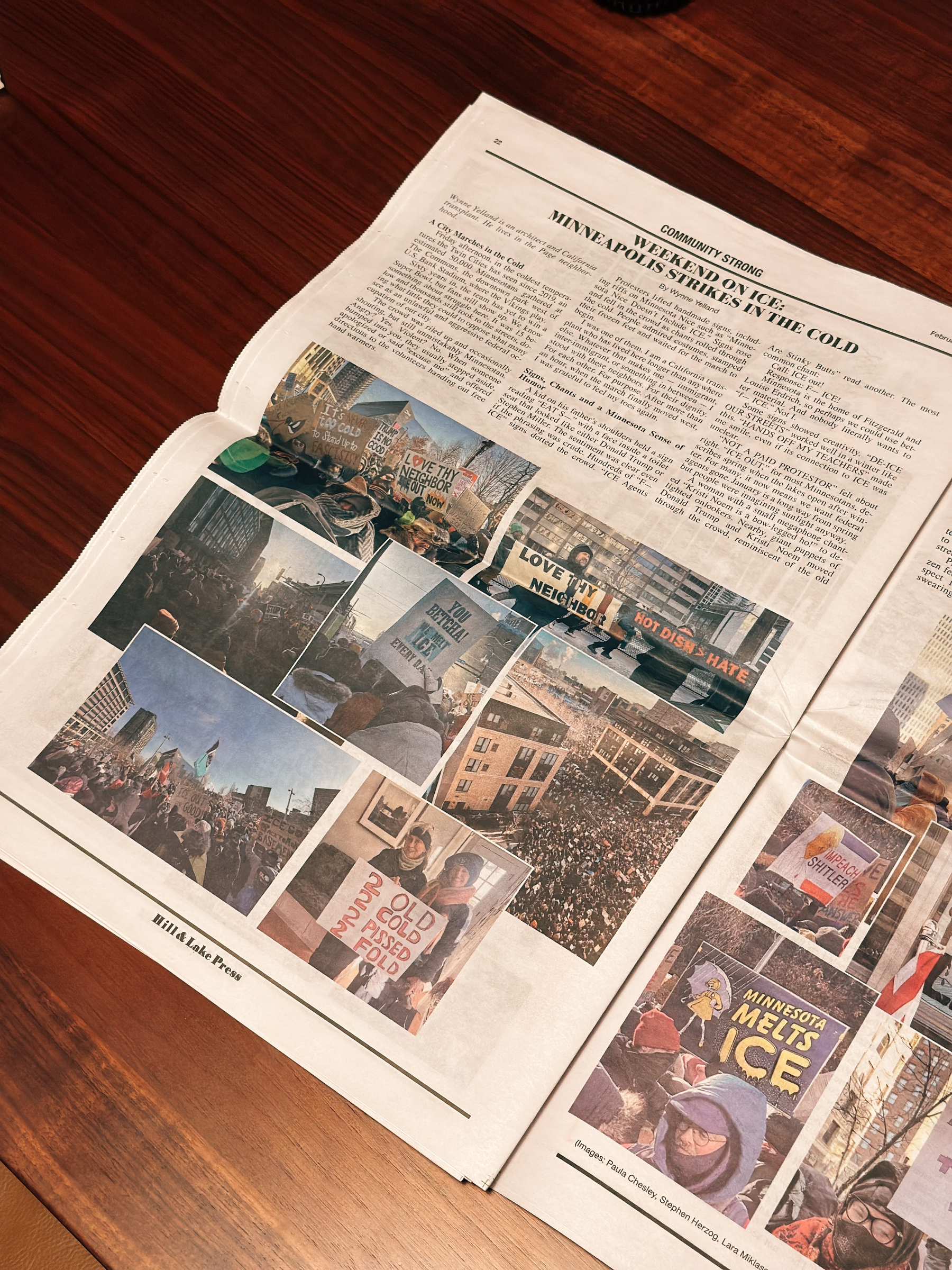
An overdue excalamation for not just the past few months, but years: I’m proud of our local Minnesota press. So many extraordinary journalists keeping tabs within communities not just within the Twin Cities, but far and wide outside them. Highlighting a few (but far from exhaustive) who have been instrumental in covering the ICE occupation here:
(Pictured - print issue of Hill & Lake Press)
Everything has to break all at once, I suppose. From The Economist, on the rapid decimation of the free press:
Journalists have plenty of faults, but preventing them from doing their jobs will have dire consequences. A vigorous newsgathering ecosystem, once destroyed, is hard to rebuild. And a world with less press freedom will be dirtier and worse-governed.
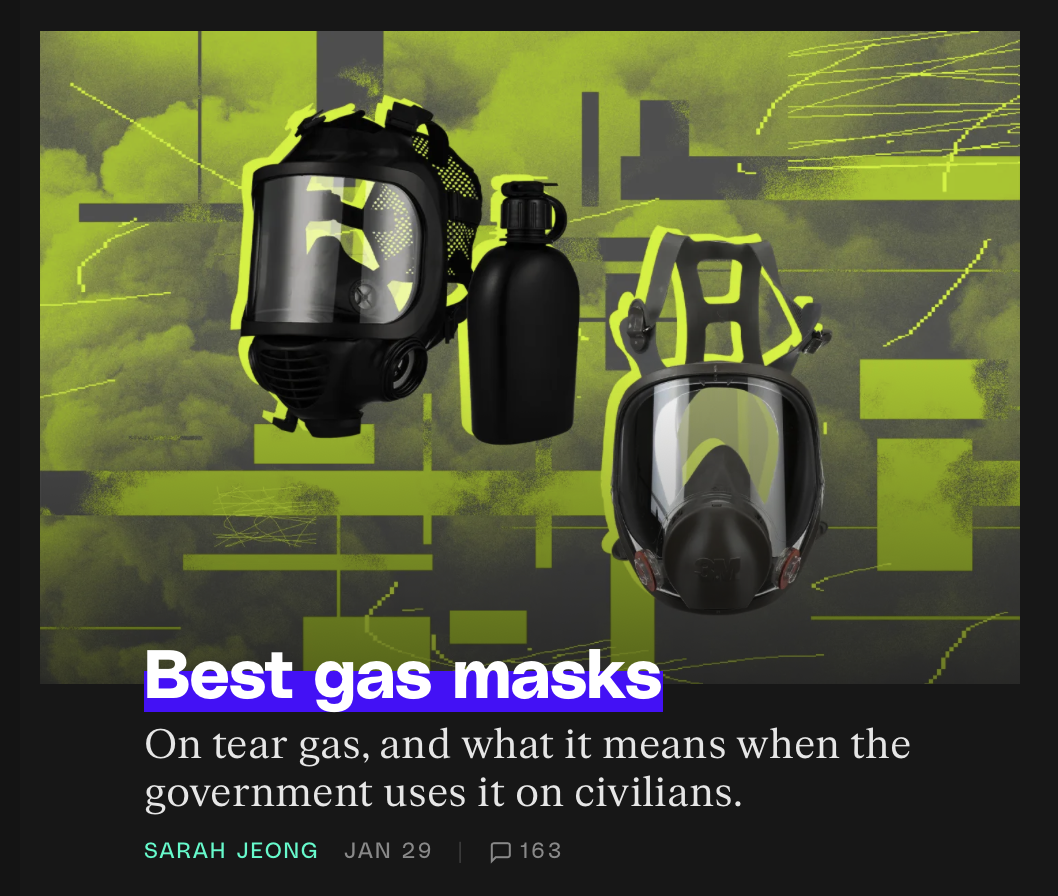
Appreciating The Verge’s work lately, including keeping us informed on the best gas masks to buy in 2026 (naturally), and doing stellar work informing the latest in Minnesota. A tech site has every right to do this (particularly in the wake of technology being used against citizens of the USA).
Small non-violent victories. A knitting shop in Minneapolis resurrects red Norwegian hats to signal defiance of ICE actions and raise mutual aid:
Since making the pattern available for $5, the shop has raised nearly $400,000, Mashaal said Friday. So far, she said, they have donated a total of $250,000 to two local nonprofits focused on housing support for immigrants in the community — STEP (St. Louis Park Emergency Program) and the Immigrant Rapid Response Fund.
The pattern for knitters is available here. An historic example of the Norwegian cap is here.
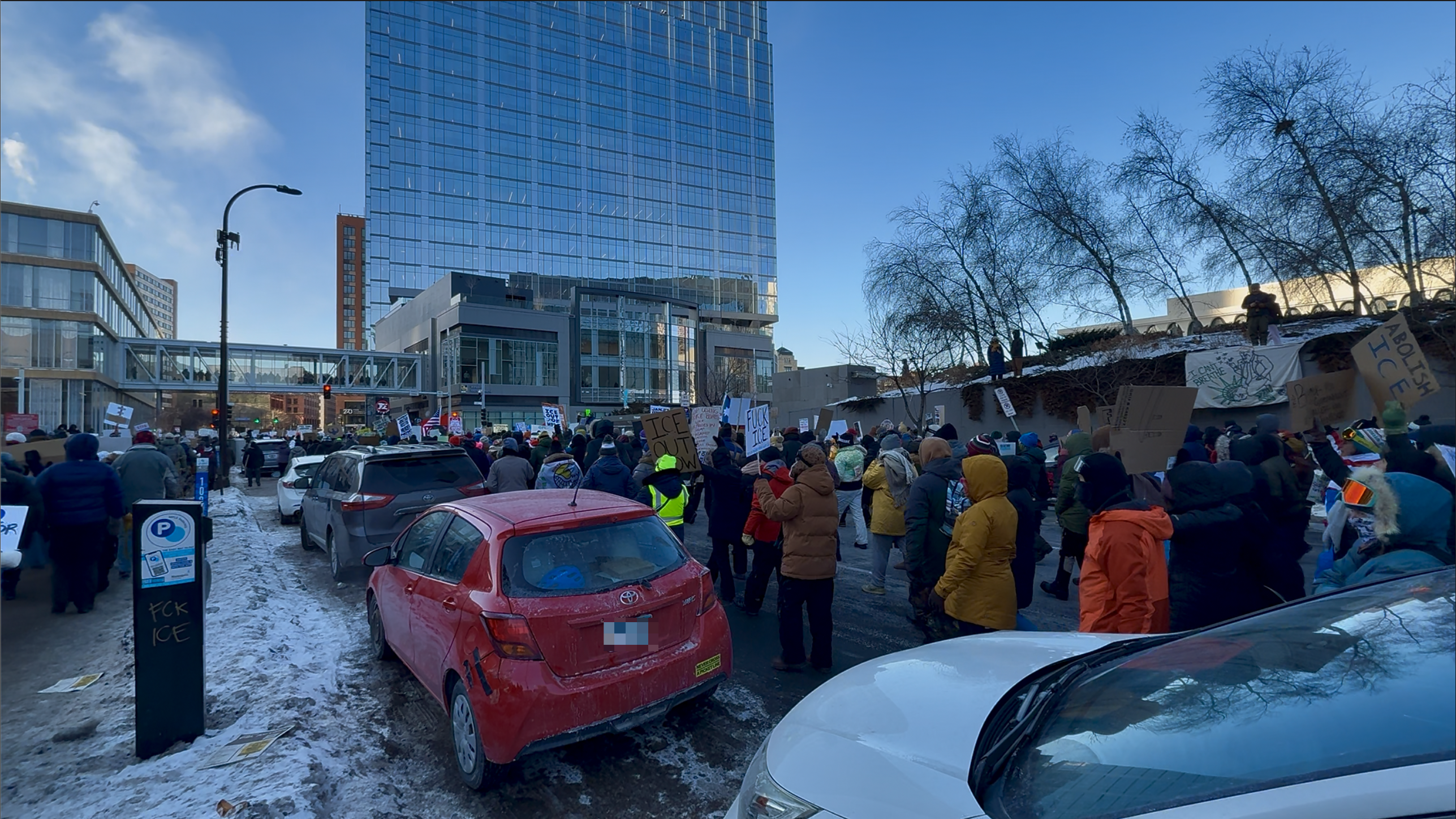
Preceding another tragic murder in Minneapolis on Saturday, the first general strike in the USA for 80 years occurred in Minneapolis on January 23, 2026. (The last one was the women-led 1946 Oakland General Strike.) This was planned over the span of a mere week, across all forms of communication — social, messaging, and stapled paper to neighborhood lamp posts. The turnout was a show of unity — an estimated 50,000+ citizens came out in -9 degrees Fahrenheit (with harsher wind chills) to the backdrop of hundreds of closed businesses, schools, and unions. It was a massive, peaceful exercise of human togetherness for the good of community in the face of injustice.
First, links to Stand With Minnesota and Minneapolis Mutual Aid, two well-curated lists for mutual aids, materials purchasing, donating, and support. There are many surrounding cities here organizing help for their neighbors and community members who are unable or fearful to leave their homes, and I want to acknowledge this isn’t just a Minneapolis-St. Paul situation, it’s state-wide, suburb-wide, rural-wide. People continue to be incredibly active and intentional in organizing support, a testament to Minnesota’s strength, resilience, adaptability, and resolve for action over words.
On the day of the strike, it was hard to discern just how many people marched together, through a twisting route westward along the avenues stemming from The Commons park adjacent to US Bank Stadium to Target Center (a nearly mile-long trek, lasting over three hours for participants). But what was easy to discern was the united front of people, together against a fearful and dire situation in their cities, and wholly bundled in winter gear and signage. There were homemade coffee carafes propped on car hoods, folks handing out hand warmers, bright-vested volunteers (or city-mandated traffic controllers, hard to tell) helping direct traffic amongst the swell of moving bodies.
A smattering of buildings and business were open. As the march wound through the city, the skyways were packed with observers. The Hennepin Public Library was permitted open as a midway reprieve of donated coffee, cookies, a spot on the floor to rub warmth back into your toes. Various small businesses along the route, shutting down their own commerce for the day, offered open doors as places to stop in for warmth. Some offered free hot dogs.
The strike was both quiet and loud, in so many ways. A scarcity of professional media added to the curious feeling. It should be said that several local outlets also went on strike. As such, I’ve curated a fair list of mainstream media and journalism coverage that reported the strike in some capacity.
In lieu of another tragedy yesterday, we hope the light that was lit here finds others across the way, and helps bind the bonds we have as people caring for the well-being of others and our country.
Generational context of invasive structure (via Racket):
Today, Fort Snelling is doing what it was designed to do: acting as a site from which Washington can project violent power over anyone who gets in its way. Dakota people saw this in the US-Dakota War of 1862, when the U.S. deployed soldiers from Fort Snelling to do battle on the Dakota. When it forced Dakota women, children, and elders into a concentration camp down the bluff from the fort. When it expelled the Dakota from their homelands and oversaw the largest mass execution in U.S. history.
And we are seeing it today as federal agents fan out from Fort Snelling into neighborhoods, seizing peaceable people, and reserving the right to shoot anyone, like Renee Nicole Good, who gets in their way.
Throughout those four minutes, almost every civilian — dressed in puffy coats and plaid flannel and fluffy knits — eventually takes their phone out to record. They are filming the cars, ICE agents, each other. One woman is walking her dog on the sidewalk at the start. She appears again to ask, “What’s happening?” to the filmer; later, she shows up in the periphery, this time with her phone out.
Derek Thompson’s interrogation into adult loneliness corresponds with a wavelength that connects to what’s going on politically, with capitalism/branding, and probably the future of the human race. It’s an astounding change in our species.
Westenberg’s How to Destroy a Generation:
When every feeling becomes a guiding star, resilience takes a back seat. Minor setbacks start to feel like existential crises, and any challenge to your perspective feels like a personal attack. Soon enough, you have a population that’s constantly on edge, unable to handle adversity, and primed to overreact to the smallest discomfort.
China tightens control of rare earth minerals — what’s the plan here?
At least Steve Ballmer is trying to reinforce the “twin pillars” of democracy and capitalism through his continued investment in USAFacts.org. What good it does is up to news organizations and government, fortunately/unfortunately — prime example:
Ballmer has taken his just-the-facts pitch to Capitol Hill, trying to convince Congress to ground its legislation in facts and to sign a document saying it believes in government data. “I don’t feel like I got much traction,” he admitted.
A lot of eyes on Minnesota over the past few days, and I’ve enjoyed seeing the country awash in midwestern banter. Also proud to see a representative from our state on the presidential ticket — Tim Walz is a tremendous, well-engineered asset and temperament on the national stage.
