In continuing to promote the “small web” of writers out there, I bumped into a site called Bubbles.town. It acknowledges the difficulty in discovering voices outside of larger properties, even with great infrastructure like the Fediverse and Kagi’s Small Web index.

They’re attempting to build a community voting system around these voices, (like HN), explaining the methodology in some detail here. What’s not to like?


Analog formats are back to save us from the inundation of digital malaise. Racket points to an “insane” demand for CRT television sets in the Twin Cities area.

Retro video gamers are the driving force, lured to the dated tech because, well, old systems look like shit on 4K LCDs. VHS and DVD enthusiasts have stoked the boom, as has a less tangible reaction to the algorithmic, AI-supercharged feeds streaming across modern TVs. The thrum, the glow, the physical media rituals—there’s analog comfort to CRTs in an increasingly ugly digital world.

I still have my Super NES for this reason alone.


Kai from Dense Discovery with a pang of sad annoyance at the state of Internet communications of late:

I know it’s a bit naïve to appeal to common decency when the same technology is busy guiding weapons systems, but please don’t outsource sincerity. Don’t pretend to care about someone or something just to get their attention. The damage isn’t just annoyance. It’s suspicion that gets attached to genuine messages. Emails I would have read warmly now carry an asterisk. Did a person write this? Does this person actually care about my work, or is this just another prompt in the dark?

This feeling extends way beyond the example he shares. The wide deployment and usage of AI has made us discerning critics of almost everything. Much like we taught ourselves to be wary of malicious email, the same now goes for every single thing anyone digitally shares with you.


✱ Kagi's Small Web is Wonderful

Kagi’s Small Web has taken me on one of the more delightful Internet journeys I’ve had in seemingly decades. They are absolutely on to something here, especially with the interface: it’s a window into the larger Internet that we used to have more easily accessible, and it feeds it to you like a well-mannered, ad-less social media app. Except, as far as I know, the algorithm is pretty random, and there is no personalization of the content curation. This makes it even better.

Here’s the rundown of what it is, how it works, and why it’s a joy to explore.

  • An open-source curated list of independent websites (comprised of a considerable amount of blogs)
  • Offering this via a web interface and either an iOS/Android app
  • Streamlined functionality: renders a random page from its Small Web index on load, with navigation buttons next/back as the driver for exploring
  • The discovery engine happens on Kagi’s domain, but hitting any links within a given site will kick you over to its proper domain.
  • From the static toolbar that loads at the top, you can also filter by pre-established topics, or view a holistic river
  • They keep the discovery fresh with posts only published in the last 7 days
  • Lastly, of course, they offer an RSS feed as well

And yes, this is being run by the alternative search engine company, Kagi, which I’ve been experimenting using and, two weeks in, has been fairly good. Great power users features, for sure, including a massive array of shortcut bangs.


I can’t get enough of Midnight Radio from James Reeves. His twice-monthly mixtape drops might just be musical prisms of my brain. His anti-bullshit music app, Spite, is worth trying in tandem with Midnight Radio (and all the owned music you’ve ever accumulated). It’s fast becoming my go-to player.


Internet linking semantics, still relevant after all these decades.


A reasonable take.

AI could have sped up the development here and there. But Jobs bet Apple’s entire future on the iPhone. And it worked because he trusted the humans he’d surrounded himself with to take one of the biggest business risks in generations. It was an irrational gamble. No machine can make that call, and never will. Innovation is a fundamentally human endeavor. We shouldn’t forget that.


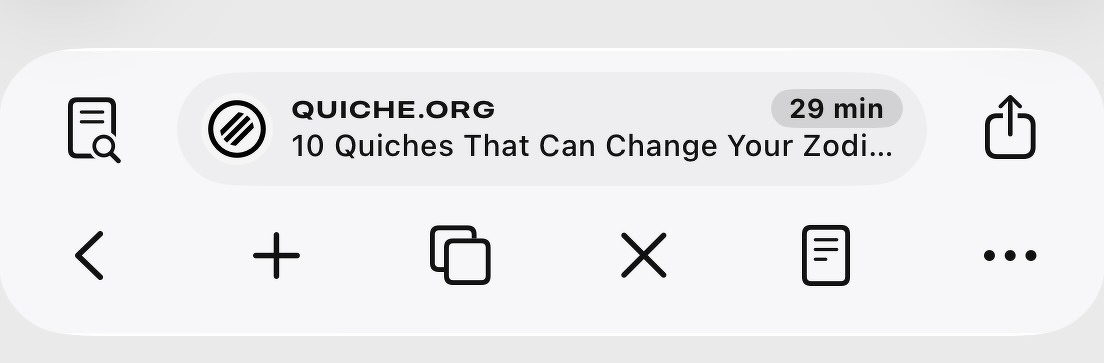
It took me no time at all once I downloaded and opened Quiche to set it as the default browser and line up a customized toolbar (just one of its excellent features). This thing is near perfect (maybe perfect?) — huge kudos to the developer.


I don’t have a particular horse in the race against social media bans / “think of the children”, but agree that something needs to be done through education, at the very least. This is such a complex issue — Craig Grannell has a pragmatic perspective. It’s hard to know how to actually get anything done against such a behemoth industry.

Social media is causing problems. Kids should be protected. But what we need is more education (for children and adults), a better understanding of available tools, along with extra – and better – regulation. What we don’t need is to start stomping around and banning semi-random chunks of the internet, only to cause more problems than end up getting solved.


A local guy invents a water bottle that cajoles the mouth and throat muscles to exercise in a way that assists snoring prevention during sleep. Some fascinating research (unexpected, as these things usually go) led to the ideation of this. Curious to see what they tackles next.


AppAddict has a well-sourced, updated list of OCR apps for Mac. Personally, I can vouch for CleanShot — it gets multiple-(and I mean multiple)-times-a-day usage from me. TextSniper was also good (my initial pick years ago), but redundant if you have CleanShot.


Information Architects’ take down of the fetishization of Microsoft Office and US software tyranny, and how Europe could break free by using “a contemporary, dynamic, simple model”. But the real nugget in here is why it’s so difficult to accomplish:

We do not dislike bad software as much as we dislike changing our behavior


Trying the new Acme Weather app by the original Dark Sky devs.

A clean, succinct interface kindly echoes the old app. Community submissions is neat, but not prominently used yet. The innovations seem to be multiple forecasts averaging and this cheeky experimental notifications pane. I’m in.

An experimental settings page labeled Acme Labs offers toggle switches to receive notifications for rainbows, auroras, and sunsets.